FOOD & CULTURE
Why Is Korean BBQ Cooked at the Table?
Walk into a barbecue restaurant almost anywhere else in the world, and the fire stays in the kitchen.
In Korea, it sits right in the middle of your table—inviting you to build the meal together.
Explain Korea
•
Culture & Dining
Walk into a barbecue restaurant almost anywhere else in the world, and the fire stays in the kitchen.
A cook you never see sears your steak, plates it, and a server carries it out to you, finished. You just eat.
Walk into a Korean BBQ restaurant, and the fire is sitting in the middle of your table.
Raw meat arrives on a plate, tongs and scissors are dropped in front of you, and — more often than not —
it's not even you who starts cooking it. It's whoever's oldest, or whoever grabbed the tongs first out of habit,
quietly managing the grill for everyone else while the conversation keeps going.
 The live fire sitting right in the middle of the table is the hallmark of Korean dining culture.
"Isn't cooking the restaurant's job? Why pay for a meal and do part of the labor yourself?"
For a first-time visitor, this can feel almost backwards. But the answer says less about barbecue technique
and more about what a "meal" is actually supposed to be in Korea.
THE ROOTS OF SHARING
To understand why a Korean BBQ table is built this way, you have to look deeper than modern restaurant design.
It is deeply rooted in traditional Korean communal culture and a long history of shared warmth.
Historically, the Korean dining table has always symbolized togetherness—a shared life among family and close neighbors.
In traditional village life, neighbors would routinely invite each other over to share a meal, rooted in a community
where people rejoiced and grieved as one. There is an old Korean saying: "Counting even your neighbor’s rice bowls."
It describes how intimately people cared for each other's lives.
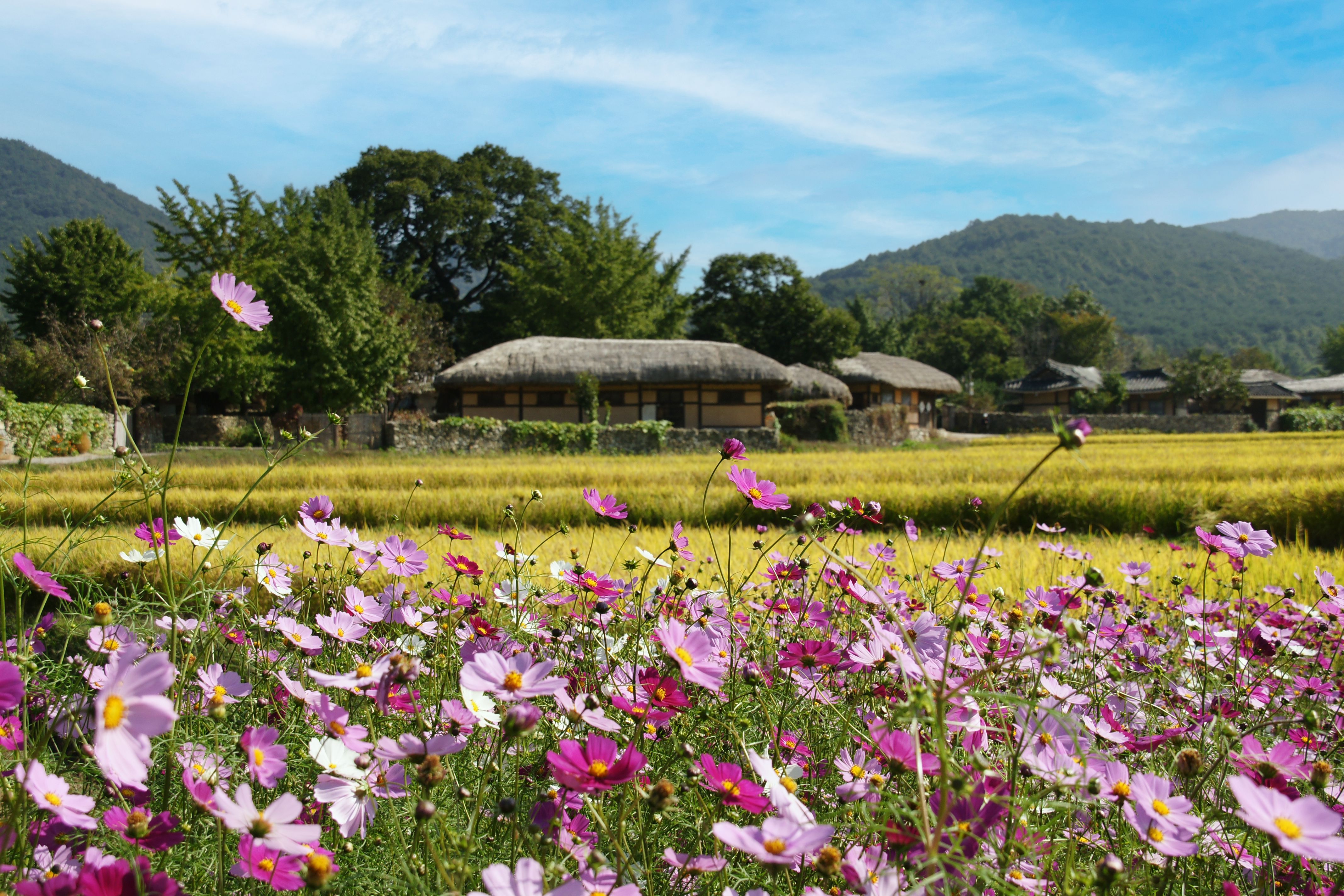 The communal warmth of old-fashioned Korean village life still echoes in modern dining habits.
When barbecue culture was introduced, it naturally absorbed this traditional sentiment. Long ago, whenever a village
butchered a pig, people from neighboring areas would travel just to buy the meat, gathering at the village entrance to
grill and eat together. Over time, that old custom evolved into the modern charcoal table-side BBQ we see today.
Today, most Koreans live fast-paced lives in massive megacities. Yet, because a vast majority grew up with roots in
close-knit rural traditions, they carry a quiet nostalgia for that old hometown warmth. Grilling meat together is a living piece of that heritage.
01
The Meal Isn't the Food — It's the Table
In a lot of food cultures, a meal is something that gets served to you.
It arrives complete, and eating it is the whole event. Korean dining, especially around BBQ,
treats the meal as something that gets built together, in real time, by the people sitting at the table.
 Nothing at a Korean table belongs to just one person; everything is shared collectively.
That's why nobody's plate arrives pre-portioned. Someone flips the meat. Someone else uses the scissors
to cut it into bite-sized pieces. Someone wraps a piece in lettuce, adds ssamjang, and hands it
to the person next to them. The unspoken assumption is that a good meal has a rhythm everyone participates in.
This is the same instinct behind why Korean tables come loaded with so many shared side dishes (banchan)
instead of individual plates. Cooking it together in front of everyone is the most literal version of that shared custody.
02
Who Grabs the Tongs Says Something
There's an unspoken social layer to who ends up managing the grill. In many groups, it defaults to the oldest person
at the table, or the one who's clearly the most senior.
A SOCIAL CUE
An Act of Care, Not a Chore
Cooking for the table isn't a chore being avoided by everyone else. It's a small, visible act of looking
after the people around you—which is why the eldest person insisting on grilling is treated as exactly what's expected.
Among close friends of similar age, this relaxes considerably—everyone grabs the tongs, everyone flips something,
and the shared cooking becomes less about hierarchy and more about tending the live fire together.
03
It's Also About Not Eating Alone
Korean has a specific discomfort with eating by yourself — enough that "eating alone" (honbap) was,
until fairly recently, considered a slightly sad thing to do.
Grilling meat table-side pushes hard against that. It physically requires more than one set of hands to do properly
and comfortably, which makes solo Korean BBQ a genuinely awkward exercise. The format itself nudges people toward eating in groups.
THE KOREAN MINDSET
Food as a Connective Event
It's the same underlying value that shows up in the reflexive question "Did you eat?" as a stand-in for "I care about you."
Food in Korean culture is rarely framed as an individual event; it's a connective one.
THE TAKEAWAY
What This Tells You Before You Even Sit Down
By the time the raw meat hits the grill, a Korean BBQ table has already made a decision about what kind of meal this is going to be:
not a transaction between a kitchen and a customer, but a shared task among the people at the table.
"So next time the tongs land in front of you, know that you're not just being handed cooking duty.
You're being handed a small piece of the meal itself."
